
How Provider Enrollment & Credentialing Works
Here's exactly what happens after you hand us your credentialing — the four stages every application moves through, and how you can watch it happen in real time. No mystery, no black box.
What is provider enrollment?
Provider enrollment is the process of getting a provider registered and approved to bill a health plan — Medicare, Medicaid, or a commercial payer — for the care they deliver.
It runs from the initial application, through the payer's review and verification, to being added to the network with an effective date so claims actually get paid. Credentialing — verifying the provider's licenses, training, and history — happens alongside it. We handle both together so nothing waits on a handoff.
Four stages, start to finish.
The four stages every application moves through, from first submission to in-network.
Application
We gather your provider and practice information once, build the applications for each payer, and get your CAQH profile complete and attested. You send us the details a single time; we handle the repetitive forms across every payer.
Verification
Credentials get verified — licensure, education, training, work history, and sanctions checks — the primary-source verification payers require. We catch the gaps that get applications kicked back before they cost you weeks.
Payer approval
We submit to each payer and work the follow-up: chasing status, answering requests for information, and pushing stalled files. This is the stage where practices lose the most time on their own, and where having a specialist on the phone matters most.
In-network
The provider is approved, an effective date is set, and they're in-network and able to bill. We confirm the details are right, then roll you into ongoing maintenance so the enrollment stays active.
After launch: From here, credentialing maintenance keeps you billable — re-attestation, revalidation, and expirable tracking (see the platform below and credentialing maintenance).
See exactly where you are — anytime.
You don't have to email us for a status update. Every provider we work with gets a live view of the work we're doing — this is the “service, not software” promise made literal: we do the work, and you see all of it.
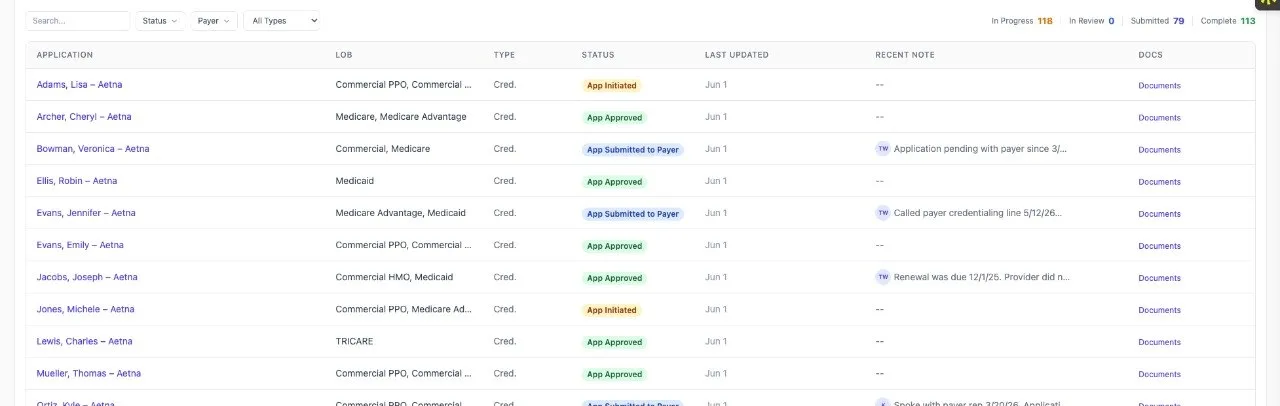
Every application, live status.
In Progress, In Review, Submitted, Complete — across every provider and every payer. Per-application status pills, the latest specialist note, and one-click access to supporting documents.
- Stages Four-state pipeline
- Notes Live specialist log
- Docs Linked in-row
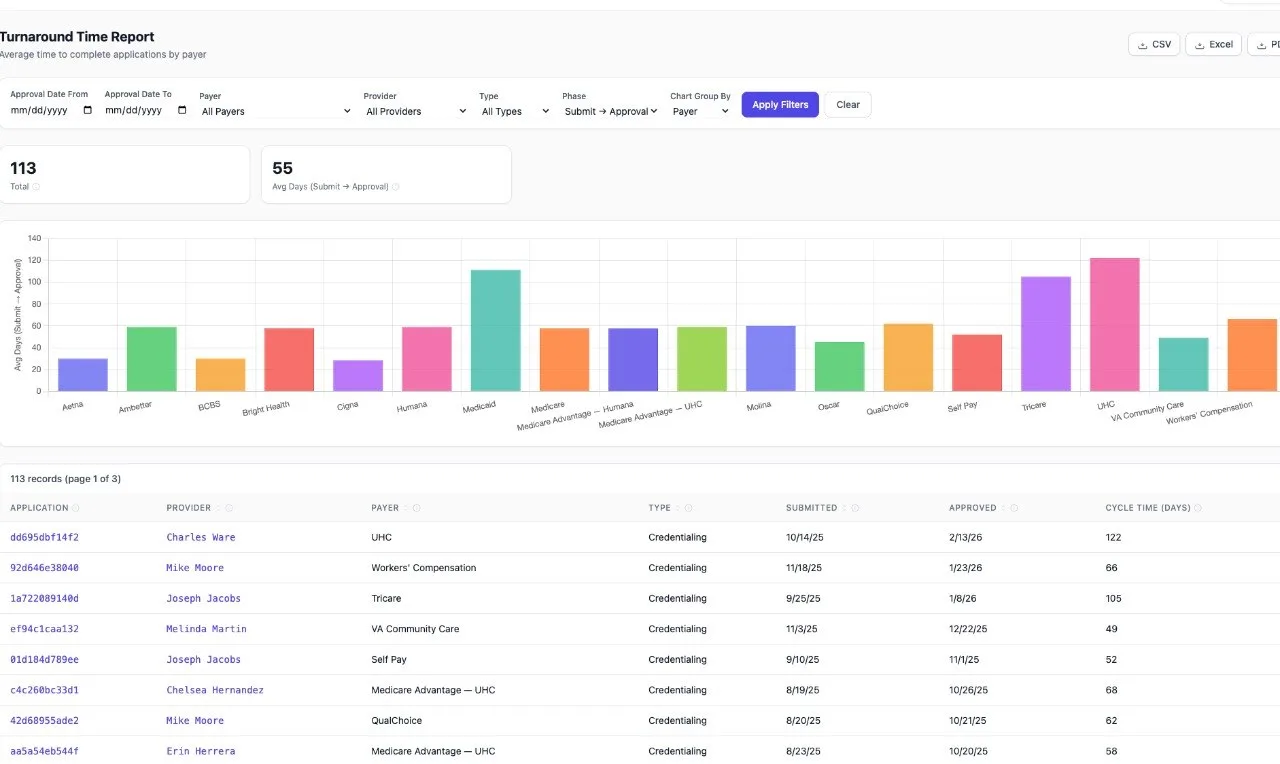
See which payers move fast. Per application.
Average submit-to-approval days, per payer. Per-application cycle times. The honest version of “faster turnaround” — the data, by name.
- Payers 100s
- View Per payer · Per app
- Export CSV · Excel · PDF
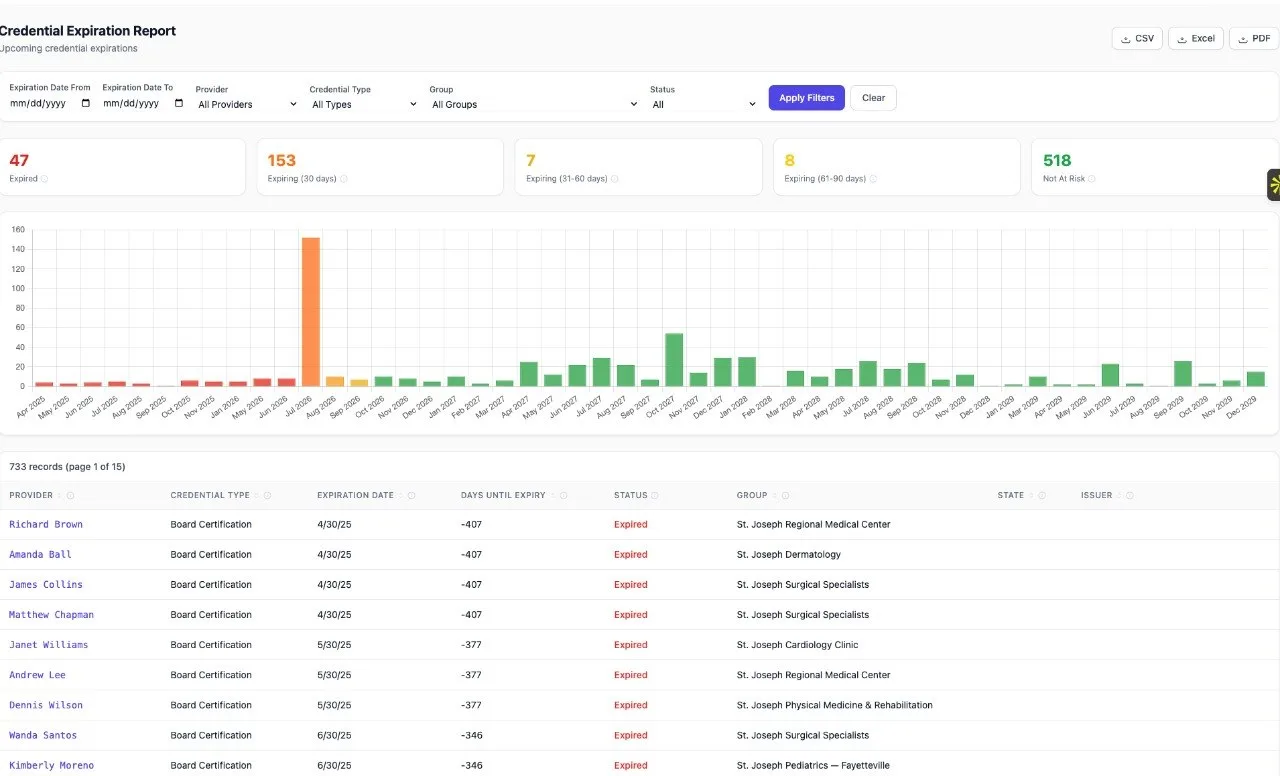
Know what's expiring — months before it does.
At-risk counts at every horizon. A five-year forward outlook chart. A filterable record table for every credential across your roster, with CSV / Excel / PDF export.
- Outlook 5 years
- Filters Provider · Type · Group · Status
- Export CSV · Excel · PDF
How long it takes — and when to start.
How long does provider enrollment take?
Most commercial payers take roughly 90–120 days, and Medicare enrollment through PECOS usually runs about 60–90 days — an overall industry range of 60–180 days.
The timeline depends on the payer, the specialty, and how complete and clean the application is (ranges reported by Verisys, EHR Source, and others). A missing document or an unattested CAQH profile can add weeks. Our job is to keep every file moving and flag problems early — but the actual approval date belongs to the payer and CMS, not to us, so we never promise a specific date.
When should we start?
As early as you can. Because a provider generally can't bill until they're approved and have an effective date, starting 90–120 days ahead of when you need them billable is the safest cushion — sooner if the specialty or payer mix is complex.
Ready to get moving?
Send us your providers and target payers and we'll get the first applications started. Clear quote, US-based team, no long-term contract.
Provider Enrollment Services is a credentialing and payer-enrollment service; approval decisions and timelines are determined by the payers and CMS, not PES.